REVIEW · SAN GIMIGNANO
San Gimignano Cathedral & Museum of Sacred Art Entry Ticket
Book on GetYourGuide →Operated by GetYourGuide Tours & Tickets GmbH · Bookable on GetYourGuide
A cathedral that teaches you to look. San Gimignano Cathedral is one of Tuscany’s medieval art stops that feels both grand and very specific, with fresco cycles that cover Bible stories across the walls. I like that this ticket turns a normal walk-in visit into a guided way to make sense of the art, and it comes with a complimentary audio guide.
Two things I really like: first, the cathedral’s interior is packed with visual details you can actually track, like the 14 stone columns (10 round and 4 octagonal) and the polychrome church decorations. Second, you get help focusing on the key fresco programs, including the New Testament work on the right wall by Lippo and Federico Memmi and the Old Testament frescoes painted in 1367 by Bartolo di Fredi.
One drawback to plan for: you’ll need to swap your voucher at the ticketing office in Piazza Pecori before you enter, so build in a little time to do that instead of rushing straight to the doors.
In This Review
- Key things to know before you go
- First Stop: Swapping your voucher at Piazza Pecori
- Enter San Gimignano Cathedral: what the space is teaching you
- Fresco roadmap: New Testament on the right wall
- Fresco roadmap: Old Testament on the left wall
- 14 columns and medieval church design: the details you’ll actually notice
- Santa Fina Chapel: the Renaissance pivot inside a medieval church
- How long to plan: make it a cathedral block, not a speed-run
- Pairing ideas: what else to fit nearby
- Languages and audio guide setup: using it without fighting it
- Price and value: why $11 can be fair here
- Who should book this, and who might skip it
- Should you book San Gimignano Cathedral ticket with audio guide?
- FAQ
- Where is the meeting point for this entry ticket?
- Do I need to exchange a voucher before entering?
- What is included with the ticket?
- Is the audio guide available in English and other languages?
- How long should I plan for this experience?
- What’s the main highlight inside the cathedral?
- Who are the artists connected to the Santa Fina Chapel?
- Is this visit wheelchair accessible?
- What’s the cancellation window?
Key things to know before you go
- Audio guide included with admission, using physical guides available in multiple languages
- Frescoes on the walls tell Old and New Testament stories, not just single scenes
- Memmi and Bartolo di Fredi are the names to watch for, and the audio guide helps you spot what matters
- Santa Fina Chapel is a Renaissance highlight inside a medieval church, with art by Giuliano da Maiano, Benedetto da Maiano, and Domenico Ghirlandaio
- You’ll see a distinctive column plan with 14 Tuscan stone columns (10 round, 4 octagonal)
- This sits among other nearby church treasures, so it pairs well with a short extra wander
First Stop: Swapping your voucher at Piazza Pecori
This experience is simple because it’s one main target: San Gimignano Cathedral. The practical part is getting your ticket in hand. Your meeting point is in Piazza Pecori, on the left of the San Gimignano Duomo, where the ticketing office handles voucher exchange.
Here’s how I’d do it if you want a smooth start. Go early enough that you’re not standing around with a crowd behind you. Once you swap the voucher, you can move on without stress. Then you’re ready to use the audio guide right away, instead of trying to figure out what you’re looking at from scratch.
Why this matters: cathedral visits go fast when you’re guessing. The audio guide included here is designed to help you slow down and connect names, scenes, and church features.
Other San Gimignano tours we've reviewed in San Gimignano


Enter San Gimignano Cathedral: what the space is teaching you
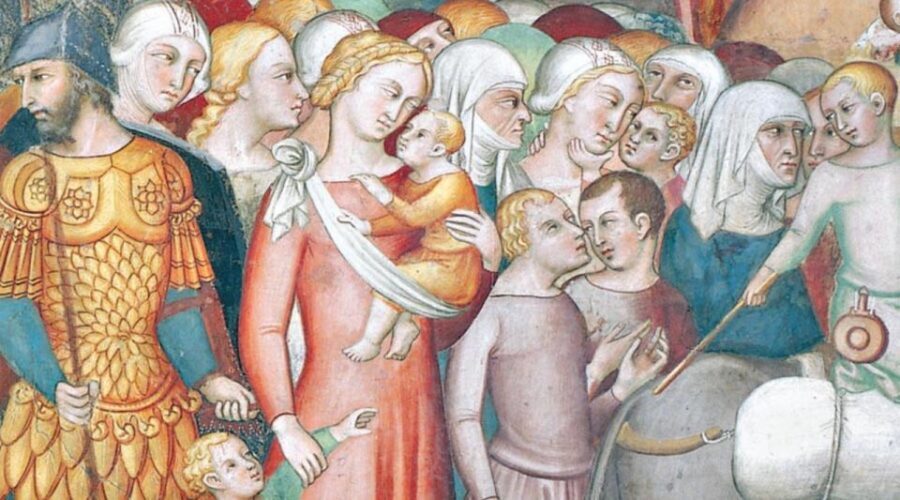
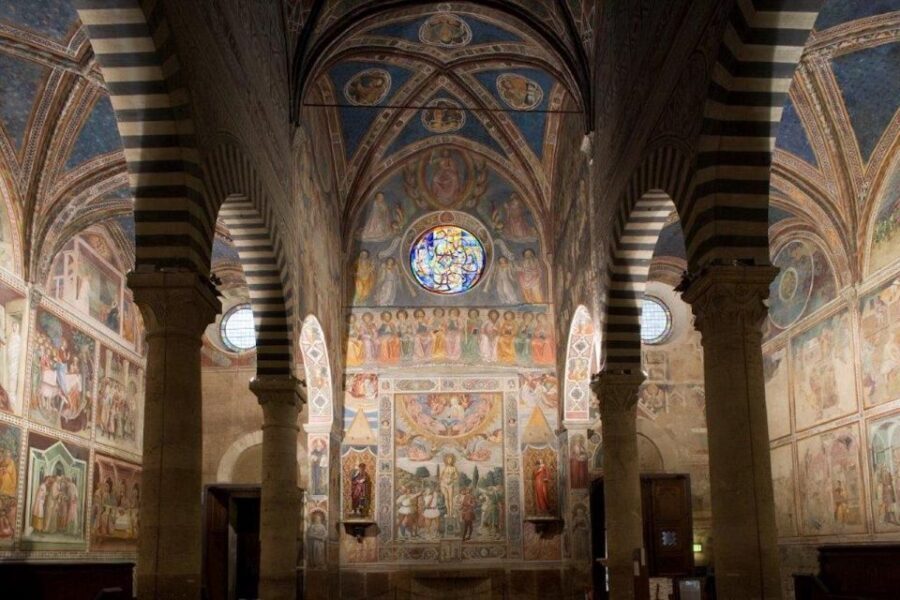
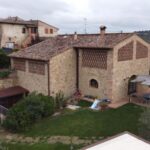
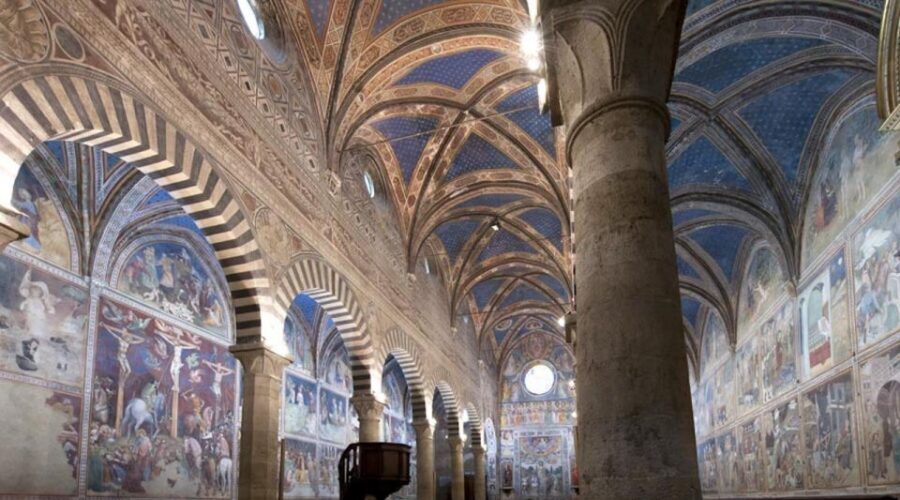
The first wow moment is not just the size. It’s the way the church is decorated for reading with your eyes. The walls are lined with frescoes that recount stories from both the New and Old Testaments, painted by artists connected to the 14th-century Sienese school.
You’ll also notice the interior structure immediately. The cathedral has 14 classical Tuscan stone columns: 10 are round and 4 are octagonal. Those shapes aren’t just architectural trivia; they help you understand how the nave and aisles are organized, and they give your brain anchors while you’re scanning wall paintings.
Then there are the medieval decorative touches that make the church feel like it belongs to its era. The interior includes polychrome elements typical of medieval churches, like:
- the painted-blue cross vault
- and the intrados of the arches between the nave and aisles, decorated with a striped motif in a style many people associate with Tuscan taste
If you like art but sometimes feel lost inside churches, this is a strong setup. Your attention has a route: columns → wall frescoes → distinctive decorations → the chapel highlight.
Fresco roadmap: New Testament on the right wall

One of the best parts of this ticket is that you don’t just see frescoes. You get a way to follow them. On the right wall, the New Testament cycle is described as a masterpiece by Lippo and Federico Memmi.
That name matters because Lippo and Federico Memmi are linked to some of the more memorable work of the period, and the audio guide helps you notice the moments that make the cycle feel coherent instead of random.
As you walk along the right-side sequence, use the audio guide to keep your place. The biggest mistake people make in fresco spaces is treating each panel like an isolated picture. Here, the cycle is the point. When you connect scenes into a story line, the art starts doing more than impressing you. It starts explaining.
And yes, it’s stunning in a quiet, almost classroom way: the church is basically teaching Bible stories in painted form, and the Memmi contribution is one of the centerpieces.
Fresco roadmap: Old Testament on the left wall
On the left wall, you’re looking at the Stories of the Old Testament, painted in 1367 by Bartolo di Fredi. Same idea as the right wall: it’s not a single painting you drift toward. It’s part of a larger program, and the date gives you a useful sense of time depth while you’re inside.
Fredi’s Old Testament cycle can feel different from the New Testament program, because the subject matter changes and the tone of episodes often shifts with it. The audio guide is especially handy here, because it helps you connect what you’re seeing to what the scenes are meant to represent.
Practical tip: don’t try to read every scene like a book. Instead, pick out a handful of key moments, then let the rest reinforce the overall pattern. The goal is to come away with a few strong images plus a sense of how the church organizes the story.
This is one of the most highly praised aspects of the visit: people consistently point to the cathedral’s frescoes as worth the time, and for good reason.
14 columns and medieval church design: the details you’ll actually notice
Even if frescoes are your main focus, the interior design keeps pulling you back into the space. Those 14 Tuscan columns create rhythm as you look forward, and they help define how the aisles relate to the nave.
If you’re the type who likes architecture but doesn’t want a lecture, you’ll enjoy this: you can spot round columns versus octagonal ones and see that the church isn’t built from bland repetition. There’s intentional variety in form.
Then there’s the medieval decoration. The painted-blue cross vault and the striped motifs in the arch intrados add color in a way that feels tied to the church’s identity, not just decorative filler. These are the kinds of details that make a cathedral feel lived-in by history.
What I like about including this as part of the ticket: it’s not just art-on-the-walls. The whole church is designed as a visual experience, and the audio guide helps you look at it as one unified program.




Santa Fina Chapel: the Renaissance pivot inside a medieval church
After you’ve spent time with the fresco cycles, you’ll hit one of the cathedral’s big “jewel” moments: the Chapel of Santa Fina.
This chapel is described as a precious Renaissance jewel inside the cathedral, and it’s tied to San Gimignano’s best-loved saint. Even if you’re not usually a “chapel person,” this one is worth slowing down for.
Three famous Florentine artists are connected to this chapel:
- architect Giuliano da Maiano
- sculptor Benedetto da Maiano
- painter Domenico Ghirlandaio
That trio matters because it means you’re not just looking at one art style. You’re seeing architecture, sculpture, and painting working together in one place.
Here’s the practical value for you: after the full-wall fresco cycles, the chapel can feel like a tighter, more focused payoff. Instead of moving along a long narrative, you’re treated to a concentrated highlight. It’s a smart way to end a cathedral visit, because it brings the medieval experience into a later Renaissance perspective.
How long to plan: make it a cathedral block, not a speed-run
This ticket is listed for a 1-day duration, and in practice that usually means you’ll do a focused cathedral visit rather than a multi-stop tour bus day. You should plan for enough time to:
- exchange your voucher
- enter and start the audio guide
- move through the fresco cycles without rushing
- spend time in the Santa Fina Chapel
If you try to do everything in ten minutes, you’ll miss the value. The reason this works as an entry ticket plus audio guide is that the art rewards time and attention.
So think of it as a half-day kind of commitment, even if you’re in town for a full day. Pair it with a relaxed walk through other nearby sacred spots only if you still have energy. The cathedral visit is the anchor.
Pairing ideas: what else to fit nearby
This ticket is cathedral-centered, but it also points you toward nearby treasures such as the Collegiata, other churches, and convents. San Gimignano is compact enough that it makes sense to string these together in a single wander, especially if you like religious art and architecture.
My suggestion: don’t turn it into a checklist. Do one cathedral well, then choose one or two additional stops based on what your feet and interest level can handle. After the Memmi and Fredi fresco cycles, you’ll probably enjoy anything that continues the theme of medieval and Renaissance sacred art, but not at the cost of time spent refocusing your attention.
Languages and audio guide setup: using it without fighting it
A big practical advantage is that the audio guide is available in English, French, German, Italian, Russian, and Spanish. Since it’s a physical audio guide option, you can grab it onsite as part of the experience as long as availability is offered at the attraction.
How to use it effectively:
- Start as soon as you enter, so the guide sets context for what you’re seeing
- Use it to track which wall and cycle you’re on (right vs left)
- Save some time for the Santa Fina Chapel, because it has multiple artist names and a specific identity
The guide is what turns “I saw frescoes” into “I understood what I saw.”
Price and value: why $11 can be fair here
At about $11 per person (plus the mention of a €1.5 booking fee), this ticket includes admission and the audio guide, which is the real driver of value.
Cathedral entry alone can sometimes feel like a blur, especially when frescoes cover walls from floor level upward. Here, the guide is built into the experience, so you’re paying for help making sense of the interior rather than just paying for access.
You also get something important for practical travelers: pre-booking. That means less last-minute searching when you’re in a historic center with limited patience for admin tasks.
And the proof is in the quality signals: the experience rates at 4.1 out of 5 with 58 reviews. The small review sample isn’t a reason to ignore the details, but it does suggest the cathedral itself is the main draw and that the ticket process is usually manageable.
Who should book this, and who might skip it
Book this if you:
- want cathedral art that’s story-driven, not random decoration
- enjoy being able to name artists like Lippo and Federico Memmi, and Bartolo di Fredi
- like architectural detail, like the mix of round and octagonal columns
- want an easier visit with an included audio guide rather than guessing your way through
Consider skipping or at least pairing differently if you:
- only want a quick exterior look
- hate audio guides and prefer a pure wander with no prompts
- get frustrated by needing a small step to exchange a voucher before entry
If you’re a careful planner, this ticket fits well. If you’re a “see it and move on” traveler, you might feel the time is best spent elsewhere.
Should you book San Gimignano Cathedral ticket with audio guide?
Yes, if your goal is to understand San Gimignano’s cathedral interior, not just photograph it. The combination of fresco cycles, named artists (Memmi, Bartolo di Fredi, and the Santa Fina trio), and the included audio guide is a solid match for most first-timers who want more meaning per minute.
You should strongly consider booking this ahead if you want to show up ready, start the audio immediately, and focus your attention on the New and Old Testament programs plus the Santa Fina Chapel. If that sounds like your style, you’ll get your money’s worth from the experience itself.
FAQ
Where is the meeting point for this entry ticket?
The ticketing office is in Piazza Pecori, on the left of the San Gimignano Duomo.
Do I need to exchange a voucher before entering?
Yes. You’ll need to exchange your voucher at the ticketing office in Piazza Pecori before your visit.
What is included with the ticket?
Your ticket includes entry and an audio guide (physical audio guide subject to availability at the attraction).
Is the audio guide available in English and other languages?
Yes. Audio guides are available in English, French, German, Italian, Russian, and Spanish.
How long should I plan for this experience?
It’s listed as 1 day. In practice, plan time to enjoy the cathedral interior and the main fresco cycles plus the Chapel of Santa Fina.
What’s the main highlight inside the cathedral?
The cathedral interior is lined with frescoes telling New and Old Testament stories, and it also includes the Chapel of Santa Fina.
Who are the artists connected to the Santa Fina Chapel?
The Chapel of Santa Fina is associated with Giuliano da Maiano (architect), Benedetto da Maiano (sculptor), and Domenico Ghirlandaio (painter).
Is this visit wheelchair accessible?
Yes, it’s listed as wheelchair accessible.
What’s the cancellation window?
Free cancellation is available up to 24 hours in advance for a full refund.